0%
Developed by autoDX · Travel operations × AI support

When travel changed after hours, customers could still get meaningful help.

autoDX developed an AI support assistant that answers policy and booking-status questions, retrieves live itinerary details, performs approved changes through tool calling and hands complex cases to a human with the full context intact.

LLM tool callingBooking APIsWhatsAppWeb chatPolicy groundingHelpdesk handoff
Talk to our team→
After-hours support

Answer, act and escalate

01UnderstandIdentify the traveller's intent and booking context.
02GroundRetrieve the relevant policy and live reservation state.
03ActCall approved booking tools when a permitted change is requested.
04EscalateSend the case to the helpdesk with transcript and tool history.
24/7digital entry point
Livebooking context
Seamlesshuman handoff
The challenge

Travel disruption happened at night; the support model still worked office hours.

A delayed flight, missed transfer or policy question could not wait until the next morning.

Phone and email queues were effective when staff were available, but repetitive after-hours requests accumulated quickly. Many questions also depended on live booking information, so a generic chatbot would not have been enough.

Limited support hoursTravellers could reach a queue but not always an immediate answer.
Repeated status questionsAgents spent time checking itinerary and booking state.
Policy complexityAnswers depended on current rules and the traveller's exact booking.
Context lossEscalated customers often had to explain the issue again.
Before autoDX

Every after-hours request waited for an agent to reconstruct the trip.

01Traveller contacts support

Phone or email becomes the entry point.

02Request waits

The case remains in queue until coverage is available.

03Agent reconstructs context

Booking, policy and previous messages are checked manually.

04Action performed

The agent makes the change in the reservation system.

05Follow-up continues

Another agent may need to rebuild the same context later.

What autoDX built

An AI support layer connected to the systems that hold the real answer.

The assistant works across WhatsApp and web chat, retrieves approved knowledge and booking state, uses controlled tools for permitted actions and moves complex cases into the existing helpdesk.

01

Intent and trip context

Identify whether the traveller needs status, policy, cancellation, transfer, accommodation or itinerary support.

02

Policy-grounded responses

Build answers from approved support content instead of relying on model memory.

03

Live booking retrieval

Read the reservation system before answering booking-specific questions.

04

Controlled itinerary changes

Expose only approved write operations with validation and traveller confirmation.

05

Cross-channel continuity

Keep conversation and itinerary context independent from the chat channel.

06

Human handoff

Create a helpdesk case with summary, transcript, booking context, tools used and unresolved decision.

Engineering

The challenge was not making the AI conversational. It was making it safe around real bookings.

01 / Technical challenge

A fluent answer could still be the wrong policy

Cancellation, change and supplier rules evolve and cannot be guessed.

How autoDX solved itThe assistant retrieves approved policy content at runtime and escalates when evidence is incomplete or ambiguous.
02 / Technical challenge

Tool calling could change a real reservation

Reading a booking is low risk; modifying it requires tighter control.

How autoDX solved itWrite tools are allowlisted, schema-validated and gated by read-before-write checks plus explicit customer confirmation.
03 / Technical challenge

Retries could duplicate a booking action

A timeout can make it unclear whether a change succeeded.

How autoDX solved itWrite operations use idempotency keys, correlation IDs and authoritative state checks before retrying.
04 / Technical challenge

A handoff without context still wastes agent time

Forwarding the last message alone does not explain the journey.
How autoDX solved itThe helpdesk receives a structured summary, transcript, itinerary references, policy evidence and attempted actions.
Solution architecture

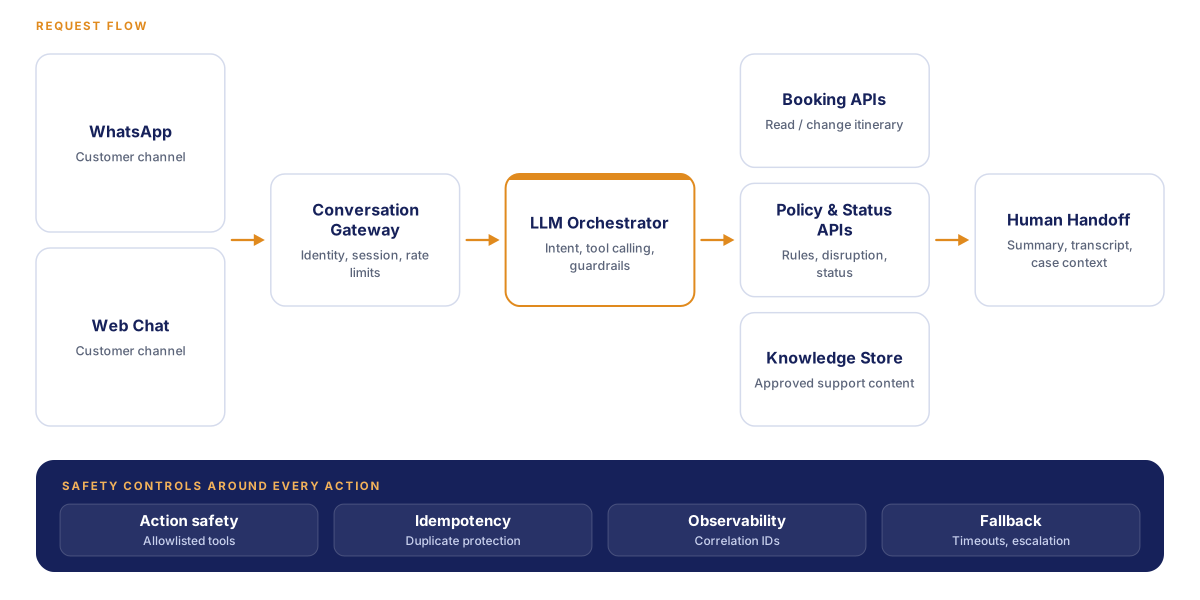
The LLM coordinates the conversation; booking systems remain the source of truth.

After-Hours AI Travel Support architecture diagram
Swipe sideways to see the full diagram.
autoDX architecture connecting WhatsApp and web chat with conversation state, LLM orchestration, approved booking tools, policy knowledge and helpdesk escalation.
Technology

AI at the conversation layer, deterministic systems underneath it.

LayerTechnologyRole
AI orchestrationLLM with tool callingIntent handling, grounded responses, tool selection and summarization.
Booking integrationReservation / booking APIsRetrieve itinerary state and perform approved changes.
Customer channelsWhatsApp and web chatProvide a consistent support entry point.
KnowledgeApproved policy and support contentGround case-specific responses.
Human supportHelpdesk integrationReceive escalated cases with context and action history.
ReliabilitySession store, queue and audit logsPreserve state, manage retries and trace actions.
Business impact

Routine requests move forward after hours without removing people from the difficult decisions.

Always-available first responseTravellers can start getting help outside staffed hours.
Live booking contextThe assistant checks the reservation system before answering.
Safer automated actionsBooking changes follow controlled tool and confirmation rules.
Consistent policy handlingResponses are grounded in approved travel policies.
Lower repetitive workloadStatus and straightforward requests do not all enter the agent queue.
Better escalationAgents receive the case with its context already assembled.
Next step

Support travellers when disruption happens, not only when the desk opens.

autoDX connects AI assistants with booking systems, policy knowledge, digital channels and helpdesk workflows to deliver practical after-hours support.