0%
Developed by autoDX · Supplier connectivity × Inventory & pricing

Adding a supplier stopped being a new integration project every time.

autoDX developed a reusable supplier integration hub that accepts different protocols and data formats, converts them into one internal model, and keeps inventory and rates synchronized through a monitored, queue-based pipeline.

REST APIsSOAP servicesETLMessage queueMonitoringPostgreSQL / MongoDB
Talk to our team→
Supplier integration hub

Different formats in. One business model out.

01ConnectReceive REST, SOAP and file-based supplier feeds.
02NormalizeMap products, inventory, rates and units into a common model.
03ProcessValidate and queue updates for independent downstream processing.
04SyncPublish consistent inventory and rate changes to core systems.
Reusableconnectors
Normalizeddata model
Observableprocessing
The challenge

Every supplier brought a different API, schema and update pattern.

One partner sent JSON, another used SOAP/XML, and others delivered files. Internally, the business still needed the same products, stock and rates.

Before the hub, each onboarding required custom mapping, separate jobs and its own failure handling. Rate spreadsheets filled the gaps when automation was incomplete, and support teams had to understand the quirks of every individual integration.

Different interfacesREST, SOAP and file feeds required different connectivity patterns.
Different schemasSKU, units, price and availability fields varied by supplier.
Manual rate maintenanceSpreadsheets were used when feeds were incomplete or delayed.
Slow onboardingIntegration logic was repeatedly rebuilt for new partners.
Before autoDX

Supplier onboarding was custom work from specification to production support.

01Review specification

A new API, XML schema or file layout was analysed.

02Build mappings

Supplier fields were translated into internal fields.

03Run separate jobs

Each supplier had its own schedule and failure behaviour.

04Reconcile manually

Rate and inventory differences were checked outside the pipeline.

05Investigate failures

Teams searched logs and files to find where processing stopped.

What autoDX built

A hub that isolates supplier-specific complexity from inventory and pricing systems.

Supplier adapters handle transport differences at the edge. The core pipeline works with one canonical model for product, stock and rate data.

01

Multi-protocol adapters

Reusable REST, SOAP and file connectors manage transport, authentication and source-specific errors.

02

Canonical data model

Supplier SKU, availability, currency, rate, units and timestamps are mapped into one internal structure.

03

Validation and ETL

Required fields, identifiers, units and rate values are checked before downstream processing.

04

Queue-based processing

Updates are buffered so a slow or unavailable destination does not block the complete feed.

05

Inventory and rate sync

Normalized changes flow through shared services into downstream inventory and pricing.

06

Monitoring and replay

Feed health, latency, rejected records and failed messages are visible and recoverable.

Engineering

The integration needed to stay reusable even when suppliers changed their formats and behaviour.

01 / Technical challenge

Supplier schemas changed independently

A field rename or new payload version could break a tightly coupled pipeline.

How autoDX solved itMappings and supplier configuration are isolated from the downstream business model so changes can be handled at the adapter boundary.
02 / Technical challenge

One failed feed could not stop every supplier

Point-to-point jobs often made failure recovery specific to each partner.

How autoDX solved itQueue-based processing isolates failures and supports retry and dead-letter handling without blocking unrelated suppliers.
03 / Technical challenge

Duplicate messages could distort stock or rates

Retries and reconnects can deliver the same supplier update more than once.

How autoDX solved itThe processing layer uses message identity and idempotent update rules before applying normalized changes.
04 / Technical challenge

Rate and inventory updates arrived on different schedules

Partial updates could create mismatched commercial and availability data.
How autoDX solved itSync state and timestamps are tracked per supplier so downstream services can apply the latest validated state consistently.
Solution architecture

Supplier-specific complexity ends at the hub boundary.

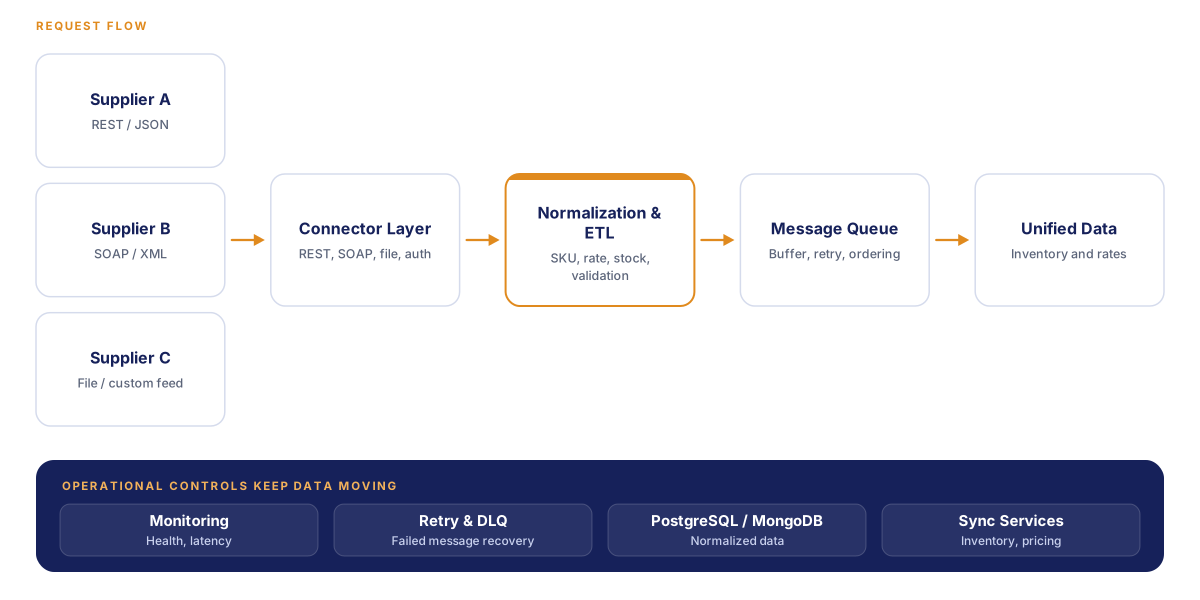
Supplier Integration Hub architecture diagram
Swipe sideways to see the full diagram.
autoDX architecture connecting REST, SOAP and file suppliers through adapters, normalization, ETL, queueing, monitoring and shared inventory/rate services.
Technology

A reusable integration stack built around consistent data and recoverable processing.

LayerTechnologyRole
Supplier connectivityREST APIs, SOAP services, file feedsConnect systems with different interface styles and payloads.
Integration & ETLETL / application servicesTransform and validate data into the canonical model.
MessagingMessage queueBuffer updates, isolate failures and support retry.
Operational dataPostgreSQL or MongoDBStore mappings, normalized records and sync state.
MonitoringLogs, metrics and alertsTrack feed health, latency, failures and rejected records.
Business impact

Onboarding became a repeatable integration capability rather than a recurring rebuild.

Faster onboarding pathNew suppliers reuse established connector, mapping and validation patterns.
Less spreadsheet dependencyRates and stock move through system-to-system workflows.
Consistent downstream dataDifferent supplier structures become one internal model.
Failure isolationA broken feed can be retried without stopping unrelated suppliers.
Clearer operationsMonitoring shows which supplier, message or mapping needs attention.
Reusable platformThe same hub supports additional suppliers and future product feeds.
Next step

Build supplier connectivity once, then reuse it.

autoDX creates integration hubs that normalize supplier data, synchronize stock and rates, and make partner onboarding easier to operate and extend.