0%
Developed by autoDX · Automotive distribution × Enterprise integration

One integration layer for partners using very different standards.

autoDX developed a shared EDI and API integration platform that replaced one-off partner connections with reusable adapters, canonical business messages, reliable queues, validation and end-to-end operational visibility.

ANSI X12EDIFACTREST APIsCanonical modelQueuesMonitoring
Talk to our team→
Partner integration

Different protocols at the edge. One managed flow inside.

01ReceiveAccept EDI documents, REST calls and partner-specific transports.
02NormalizeTranslate orders, inventory, shipments and invoices into shared business messages.
03ProcessValidate, route and deliver through queue-backed services.
04TraceTrack acknowledgement, processing status, errors and replays.
EDI + APIshared platform
Canonicalbusiness messages
Traceableprocessing
The challenge

Every new trading partner became another integration project.

Partners used different standards, transports and message structures, while internal systems still needed consistent orders, inventory, shipment and invoice data.

Point-to-point connections duplicated mapping and validation logic. A partner change could trigger code changes, and support teams had to inspect different logs and interfaces to understand whether a document had been received, rejected or delayed.

Protocol diversityPartners used X12, EDIFACT, REST and different transports.
One-off mappingsTransformations were repeated across partner connections.
Operational blind spotsMessage status was difficult to follow end to end.
Change overheadPartner-specific updates could affect core integration code.
Before autoDX

Partner connectivity worked, but each connection carried its own complexity.

01Partner format received

The team reviews the standard, transport and message structure.

02Custom mapping built

Partner fields are transformed directly for a target system.

03Point-to-point routing

The connection delivers into ERP, OMS or WMS.

04Failures investigated

Support checks partner-specific logs and acknowledgements.

05Changes repeated

New partners or schema changes start another integration cycle.

What autoDX built

A managed partner-integration layer with shared internal contracts.

EDI translators and API adapters handle partner differences at the edge. Inside the platform, data follows consistent validation, routing, queueing and monitoring patterns.

01

EDI and API adapters

Support partner-facing X12, EDIFACT and REST interfaces without exposing that complexity to core applications.

02

Canonical message model

Normalize orders, inventory, shipments and invoices into shared internal contracts.

03

Partner configuration

Keep mapping, routing and partner rules separate from core application logic where practical.

04

Reliable messaging

Use durable queues, acknowledgements and controlled replay to protect business processing.

05

Validation and security

Apply schema, business-rule, transport and access checks before messages reach enterprise systems.

06

Monitoring and alerts

Use correlation IDs and common status tracking to follow a message from receipt through delivery.

Engineering

The platform had to support partner differences without letting those differences spread through internal systems.

01 / Technical challenge

Standards and versions varied by partner

X12, EDIFACT and REST payloads represent similar business events differently.

How autoDX solved itAdapters translate partner-specific structures into canonical internal messages before business processing.
02 / Technical challenge

Reliable delivery mattered more than a single successful request

Downstream ERP or WMS services can be unavailable while partner traffic continues.

How autoDX solved itDurable queues, acknowledgement handling and controlled retries separate receipt from downstream availability.
03 / Technical challenge

Retries could create duplicate business transactions

A replayed purchase order or invoice must not create a second transaction.

How autoDX solved itMessage identity, correlation references and idempotent processing rules are applied before enterprise updates.
04 / Technical challenge

Support needed one place to trace failures

Partner-specific logs slowed incident diagnosis.
How autoDX solved itCommon status, error categories and correlation IDs make receipt, validation, routing and delivery visible in one operational flow.
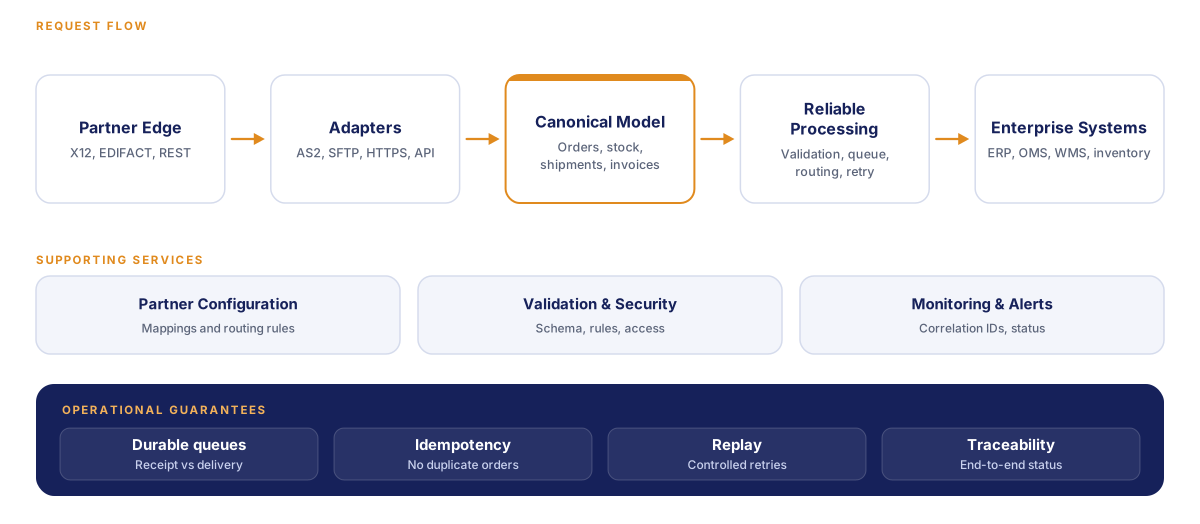
Solution architecture

Partner-specific protocols feed one dependable integration backbone.

EDI & API Partner Integration architecture diagram
Swipe sideways to see the full diagram.
autoDX architecture for EDI & API Partner Integration.
Technology

Standards-led integration with reliable delivery and operational visibility.

LayerTechnologyRole
EDI standardsANSI X12 / UN EDIFACTStructured trading documents and acknowledgement flows.
TransportAS2, SFTP, HTTPSSecure partner message exchange.
API connectivityREST, JSON, OpenAPI, OAuth 2.0 / API keysSchema-driven partner APIs and authentication.
Integration servicesEDI translators / custom or managed servicesTranslation, routing, validation and transformation.
MessagingDurable queue or event brokerRetry, backpressure and failure isolation.
ObservabilityCentral logs, metrics, dashboards and alertsMessage tracing and incident response.
Enterprise systemsERP, OMS, WMS, inventory servicesProcess orders, stock, shipments and invoices.
Business impact

Partner connectivity became easier to operate and extend.

Reusable onboardingNew partners start from established adapters, mappings and internal contracts.
Clear processing statusTeams can distinguish received, validated, rejected, queued and delivered messages.
Faster issue diagnosisCorrelation IDs and common error categories narrow investigation.
Safer partner changesConfiguration isolates many partner differences from core applications.
Better continuityQueues and controlled replay protect processing during downstream outages.
More consistent dataShared internal definitions reduce partner-specific handling inside business systems.
Next step

Connect partners without multiplying point-to-point complexity.

autoDX builds integration platforms that support EDI and APIs through reusable mappings, reliable delivery and clear operational visibility.