0%
Developed by autoDX · Healthcare interoperability × Secure data exchange

Patient information could move between systems without relying on re-entry and email attachments.

autoDX developed a secure integration layer that connects clinical records, billing and laboratory systems through controlled interfaces, with consent, identity, encryption and auditability built into the data exchange.

HL7 / FHIR APIs.NET / Node.jsEncrypted storageIdentity & accessConsentAudit logging
Talk to our team→
Secure health data exchange

Connected systems with governed access

01ConnectIntegrate approved clinical, lab and billing systems.
02TransformValidate and map information between supported formats.
03AuthorizeApply identity, access and consent context to the exchange.
04AuditRecord important access and data movement events.
Standards-awareintegration
Controlledaccess
Traceableexchange
The challenge

The patient record was split across tools that did not share information cleanly.

Clinical teams, laboratories and billing systems each held part of the same patient journey.

Staff re-entered information, moved files by email and switched between applications to reconstruct context. That created duplicate work, slower handoffs and more opportunities for inconsistent records.

Repeated entryThe same information was typed into more than one system.
Email handoffsFiles moved between teams outside structured application interfaces.
Fragmented contextClinical, lab and billing users saw different pieces of the journey.
Limited traceabilityIt was harder to follow who accessed or exchanged information.
Before autoDX

People became the integration layer between healthcare systems.

01Open clinical record

Staff retrieve patient and encounter information.

02Re-enter details

Relevant fields are copied into another application.

03Send files

Documents or results are shared through email or manual upload.

04Update billing or lab

The next system is updated independently.

05Reconcile later

Teams investigate mismatches across separate records.

What autoDX built

A governed integration layer that exchanges data between approved healthcare systems.

The solution uses standards-based interfaces where suitable and keeps validation, transformation, identity, consent and audit responsibilities inside the integration layer.

01

HL7 / FHIR connectivity

Exchange structured clinical and administrative information through supported healthcare interfaces.

02

Integration services

.NET or Node.js services validate, transform and route data between connected systems.

03

Consent-aware exchange

The workflow carries the required consent and authorization context into data movement.

04

Identity and access

Users and services are authenticated and restricted to approved roles.

05

Encrypted data handling

Sensitive information is protected in transit and when persisted by the integration platform.

06

Audit logging

Important access, exchange and processing events are recorded for operational traceability.

Engineering

Interoperability only worked when the data and security rules travelled together.

01 / Technical challenge

Systems represented the same information differently

Clinical, lab and billing systems used different field structures and exchange patterns.

How autoDX solved itThe integration services validate and transform payloads into the receiving system's supported contract while preserving the business meaning.
02 / Technical challenge

Access rules differed by workflow

A technically reachable system should not automatically make every record available.

How autoDX solved itIdentity, authorization and consent checks are applied as part of the exchange path rather than as a separate manual step.
03 / Technical challenge

Failures needed to be visible

A dropped or rejected message could leave two systems showing different states.

How autoDX solved itProcessing status and audit events make failed exchanges traceable so support teams can identify where the handoff stopped.
04 / Technical challenge

Security had to cover stored and moving data

Healthcare information passes through services as well as databases.
How autoDX solved itEncryption and controlled service access protect data in transit and at rest across the integration layer.
Solution architecture

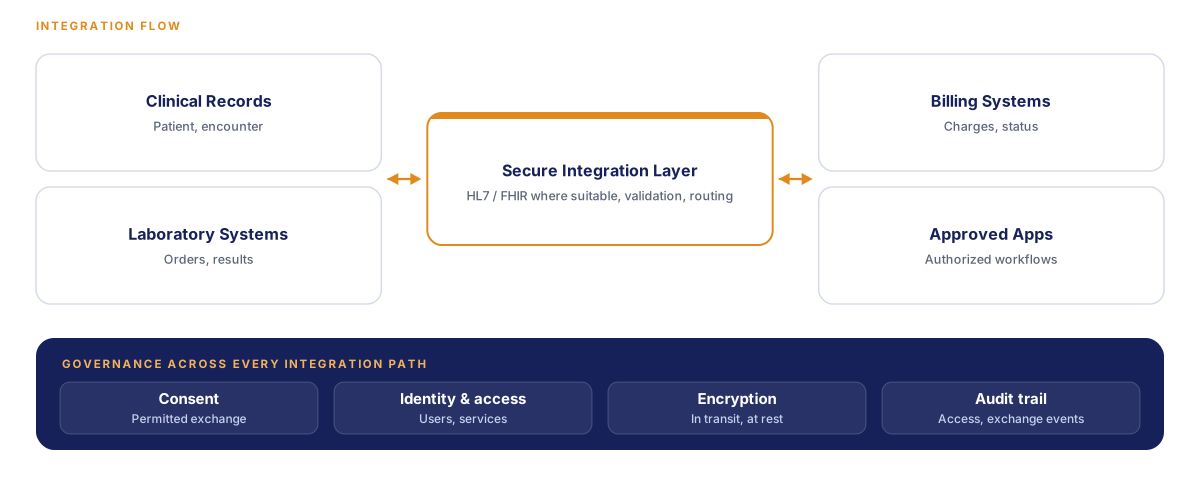
One controlled integration layer connects records, laboratories and billing.

Secure Healthcare Data Exchange architecture diagram
Swipe sideways to see the full diagram.
autoDX architecture connecting clinical records, laboratory and billing systems through integration services with consent, identity, encryption and audit controls.
Technology

Interoperability, application logic and security kept as clear responsibilities.

LayerTechnologyRole
Healthcare interoperabilityHL7 / FHIR APIs where suitableExchange structured clinical and administrative information.
Integration services.NET or Node.jsValidate, route and transform data between systems.
Data protectionEncrypted storageProtect sensitive information persisted by the platform.
Identity & authorizationIdentity and access managementAuthenticate users and services and enforce role-based access.
Operational governanceConsent context + audit loggingTrace approved data exchange and access events.
Business impact

Less manual copying, cleaner handoffs and better visibility into how information moves.

Reduced duplicate entrySystem-to-system exchange replaces repeated re-keying.
Fewer email handoffsApproved interfaces move information between connected applications.
Better continuityClinical, laboratory and billing workflows share more consistent context.
Controlled accessIdentity and consent remain part of the integration path.
Improved traceabilityAudit records make important exchange events easier to follow.
Reusable integration layerAdditional approved systems can connect through the same governed pattern.
Next step

Connect healthcare systems without losing control of the data.

autoDX builds secure integration layers that reduce manual handoffs while keeping identity, access and auditability inside the architecture.